Machine Types
Machine Types
(Page currently under construction)
This gives you an overview of the default machine-types in their standard configuration. Remember you can change almost any property of those, including but not limited to the entire interface. E.g. when you see the Battery-Block here, you might by virtue of the configuration have 5 Tiers of battery blocks with increasing capacity.
Basic Properties of each machine
Each machine has their own properties, however some of them have common settings. They'll be explained here.
ExampleMachineNotUsable:
  version: 1
  class-name: .ClassName
  display-name: Display Name
  inventory:
    layout: '000000001022003307000000000888888888'
    size: 36
| Property | Function |
|---|---|
| class-name | The name of the class this machine should have. This acutally determines what code will be executed for the machine. Do NOT Change this if you want the same machine with other properties! Class Names beginning with a . point to com.dxdydxdy.Machines.ActualMachines. If you're not using one of the integrated machines, the author of the machine-jar has to provide you with a class-name. |
| display-name | The display name of the machine. |
| inventory.layout | The inventory layout. Every number represents a slot in the inventory. The numbering convention is as follows * 0 - Background Item (Obsidian) * 1 - Machine Identificator * 2 - Basic input slot * 3 - Basic output slot * 8 - Progress slot which displays visually how near to the next processing step the machine is. |
| inventory.size | The size of the inventory. It has to be divisible by nine. You can change the layout as well as the size freely, at least the integrated machines will take that into account and use the slots you specified. |
Electrical Machines Machines which use the electricity system have two more properties.
  electricity:
    internal-storage-max: 1000
    is-provider: false
| Property | Function |
|---|---|
| internal-storage-max | Determines the size of the internal storage. You should always make this value not too big, but bigger than the energy which the machine requires to advance a single step |
| is-provider | Is this machine a provider to others. This should only be true for batteries and generators of any kind. Machines which have this property set will not attempt to draw energy from other machines in the power-grid (the exception are batteries on their input-side) |
Energy Supply
Battery-Block

The battery block is the basic means of energy storage. It allows you to store a configurable amount of energy. It has an input-face at the top, every other face acts as an output.
BasicBattery:
  version: 1
  class-name: .BatteryBlock
  display-name: Basic Battery
  electricity:
    internal-storage-max: 10000
    is-provider: true
  inventory:
    layout: '000070001'
    size: 9
internal-storage-max: The max. amount of energy this machine can store.
Recipe
BasicBattery:
  shaped: false
  ingredients:
    - GOLD_INGOT;10
    - REDSTONE;20
  result: Book;BasicBattery
ItemEnergyLink

This machine is a baisc generator. It allows yo to insert items. The items are then converted into energy using a mapping specified in the configuration.
ItemEnergyLink:
  version: 1
  class-name: .ItemEnergyLink
  display-name: Item-Energy-Link
  passive-generation: 0.0
  electricity:
    internal-storage-max: 300
    is-provider: true
  inventory:
    layout: '000020071'
    size: 9
  recipes:
    - COAL;100.0
| Property | Function |
|---|---|
| recipes | Allows you to specify your recipes. Each recipe is in the format of "MATERIALNAME;Amount of Energy". Click here for a list of Material Names. |
Recipe
ItemEnergyLink:
  shaped: false
  ingredients:
    - IRON_INGOT;5
    - REDSTONE;20
    - COBBLESTONE;10
  result: Book;ItemEnergyLink
Producing Machines
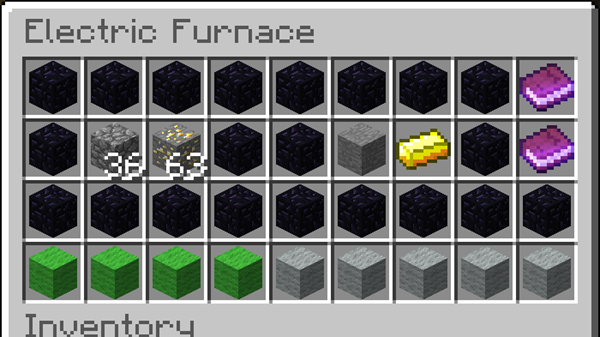
Electric Furnace

Recipe
BetterFurnace:
  shaped: false
  ingredients:
    - GOLD_INGOT;10
    - IRON_INGOT;10
  result: Book;ElectricFurnace
Disenchanter

The disenchanter allows you to retrieve the enchantments from an already enchanted Item. Each enchantment on the original item is put into its own Enchanted Book. You can configure a damage-value threshold below which no enchantments are retrieved.
Disenchanter:
  version: 1
  class-name: .Disenchanter
  display-name: Disenchanter
  MaxProgress: 20
  el-per-tick: 30
  durability-percentage: 50
  ignore-level-restrictions: false
  electricity:
    internal-storage-max: 1000
    is-provider: false
  inventory:
    layout: '000000001020033307020033300888888888'
    size: 36
| Property | Function |
|---|---|
| MaxProgress | Every two seconds the progress-counter is incremented by one (if there's enough energy). This determines the point at which the progress is full and the action made. |
| durability-percentage | Up to which percentage of its maximal durability can the enchantments get removed from the item. |
| ignore-level-restrictions | If this is set to true, any enchantment above the levels that are possible using the normal game mechanics will not be retrieved. An enchanted book without enchantment will appear instead. |
| el-per-tick | The amount of energy the machine needs in order to increment the progress by one. |
Recipe
Disenchanter:
  shaped: false
  ingredients:
    - ENCHANTMENT_TABLE;1
    - BOOKSHELF;4
    - GOLD_INGOT;10
    - IRON_INGOT;15
  result: Book;Disenchanter

ItemGenerator
The ItemGenerator allows you to trade time and electricity for items. However, in order to do that, it has to be surrounded by water. The default variety this machine comes in is 'Fisher'.
- Water Layout*: X = Still(!) Water 0 = ItemGenerator
X X X
X 0 X
X X X
Fisher:
  version: 1
  class-name: .ItemGenerator
  display-name: Fisher
  MaxProgress: 20
  el-per-tick: 150
  give-item:
    ==: org.bukkit.inventory.ItemStack
    type: RAW_FISH
    amount: 2
  electricity:
    internal-storage-max: 1000
    is-provider: false
  inventory:
    layout: '000000001000333007000333000888888888'
    size: 36
| Property | Function |
|---|---|
| give-item | The ItemStack that is given to the player once the conversion has finished. |
| el-per-tick | The amount of energy the machine needs in order to increment the progress by one. |
Recipe
Fisher:
  shaped: false
  ingredients:
  - FISHING_ROD;1
  result: Book;Fisher
Comments